What it takes to prove binary search works

In my previous article about Proof Driven Development, I wrote about using formal specifications to check whether code does what we agreed it should do. Microsoft Research’s PDD Kit uses Verus for Rust, though, and most of my work is in JavaScript. So I was left with a question: what can I actually try without rewriting my whole application in Rust?
I ended up trying Dafny. With help from a coding agent, I wrote and verified a small binary search, deliberately broke it, and compiled the working version to JavaScript.
If you haven’t heard of Dafny, it’s an open-source programming language and verifier. You write code and describe what must be true before and after it runs. Dafny checks the code against those rules using a solver called Z3, and can compile it to languages including JavaScript.
What is Z3?
Z3 is a solver: you give it logical constraints and it checks whether they can be satisfied. Dafny uses it to help check whether the code could violate the rules we wrote.
Why binary search?
If you don’t know binary search, don’t worry: the internet definitely doesn’t have enough articles about it yet. I even wrote one of them a few years ago, including the most important requirement:
- Your list must be sorted.
- Your list must be sorted.
- Your list must be sorted.
Still true! Binary search looks at the middle of a sorted collection, discards the half that can’t contain the value, and repeats. That sounds simple until you have to decide what happens with an empty array, a missing value, duplicates, or a search range with one element left.
I wanted to see what it would take to check those cases without listing each input in a test. So I wrote down what a correct result should look like and asked Dafny to check the implementation against it.
What are we actually promising?
Here’s the contract I used:
method BinarySearch(a: array<int>, key: int) returns (index: int)
  requires forall i, j ::
    0 <= i < j < a.Length ==> a[i] <= a[j]

  ensures index == -1 <==>
    forall k :: 0 <= k < a.Length ==> a[k] != key

  ensures index != -1 ==>
    0 <= index < a.Length && a[index] == key
requires is the condition the caller must satisfy: the array is sorted in ascending order. Equal values are allowed.
The first ensures says the result is -1 if and only if the value is absent. The second says that any other result must be a valid index containing the value. If there are duplicates, returning any matching index is fine; this contract doesn’t ask for the first one.
In other words, there are two cases: if the value is missing, return -1; if it exists, return an index where it appears. Both clauses work together: the first describes when -1 is allowed, and the second checks that any other result points to the value.
The implementation needs an explanation too
Here is the complete method, including the loop invariants:
method BinarySearch(a: array<int>, key: int) returns (index: int)
  requires forall i, j ::
    0 <= i < j < a.Length ==> a[i] <= a[j]
  ensures index == -1 <==>
    forall k :: 0 <= k < a.Length ==> a[k] != key
  ensures index != -1 ==>
    0 <= index < a.Length && a[index] == key
{
  var low := 0;
  var high := a.Length;

  while low < high
    invariant 0 <= low <= high <= a.Length
    invariant forall k :: 0 <= k < low ==> a[k] < key
    invariant forall k :: high <= k < a.Length ==> key < a[k]
    decreases high - low
  {
    var mid := low + (high - low) / 2;

    if a[mid] < key {
      low := mid + 1;
    } else if key < a[mid] {
      high := mid;
    } else {
      return mid;
    }
  }

  return -1;
}
The search range is [low, high): it includes low, but not high. At the beginning, that’s the whole array. At the end, when low == high, there’s nothing left to search.
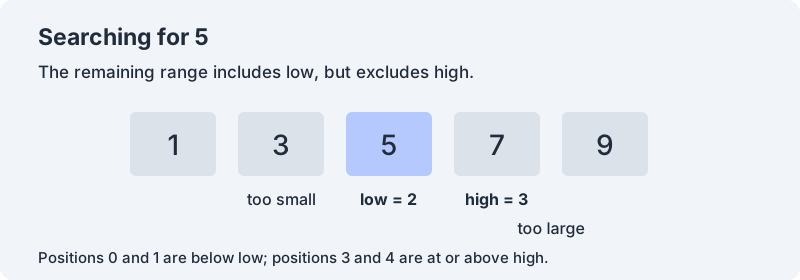
The invariants describe what must remain true throughout the loop. The first keeps the range inside the array. The other two say that everything before low is smaller than the key, and everything at or after high is larger. If we find the key, we return its index. If the range becomes empty, those two facts explain why the key can’t be anywhere in the array.
decreases high - low is the termination argument. The verifier checks that the remaining range gets smaller on each iteration that continues the loop. Without that check, we could miss a search that gets stuck repeating the same step.
With Dafny 4.11.0, the verifier reported:
Dafny program verifier finished with 3 verified, 0 errorsThose three verified items are the verifier’s reported count for the sample; they aren’t a count of all the individual properties. The method’s contract, bounds and termination are checked under its precondition. Dafny’s guide goes into more detail on preconditions, postconditions and invariants.
Let’s break it
I changed one line:
- low := mid + 1;
+ low := mid;
The middle value is too small, so moving the lower bound to the middle might seem reasonable. But we already checked that position; we need to move past it.
Suppose we’re looking for 6 and only 5 remains. low and mid are both 2, so setting low to mid leaves the range exactly where it was:
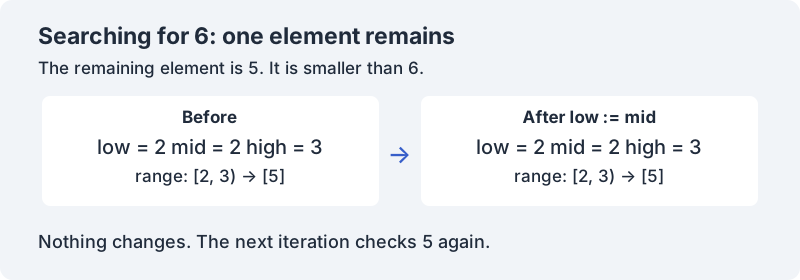
The next iteration checks 5 again, and the one after that does the same. With low := mid + 1, low becomes 3, the range is empty, and the search returns -1.
Dafny rejected the changed version:
Error: decreases expression might not decrease

Dafny program verifier finished with 2 verified, 1 error
The error doesn’t spell out the one-element case, but it points us to the right place: the search range isn’t guaranteed to shrink.
But I write JavaScript
Dafny can compile to JavaScript. I compiled this sample with dafny build --target js and ran the generated program with Node. For [1, 3, 5, 7, 9], it returned 3 for 7 and -1 for 4.
The generated JavaScript uses bignumber.js for Dafny integers. It also includes generated runtime code, so this isn’t the same experience as adding a type annotation to an existing JavaScript function. To call the generated method from an application, we need an integration layer that supplies values in the expected representation. I tried that separately with a small session-policy function; the generated sample needed an export added before a Node wrapper could call it.
And remember the first rule? The array must be sorted. Dafny checks that calls from verified Dafny code satisfy the requires clause; our sample’s Main does. But the search method itself assumes its input is sorted, and the generated JavaScript doesn’t automatically check an array supplied by a JavaScript caller. We need to establish that guarantee at the boundary or elsewhere in the application. Checking every element on every call takes linear time, which can outweigh the benefit of binary search.
We also need to check how the JavaScript adapter converts values. Dafny integers are mathematical integers; JavaScript Number values have their own limits.
The proof also doesn’t establish that we picked the right behavior. If the product needs the first occurrence of a duplicate, our current contract allows a different matching index. Dafny can verify exactly what we asked for and still leave the product team asking why the result isn’t the one they expected.
How is this different from TDD?
With TDD, I could start with a failing test for searching [5] for 6, then write the search until that test passes. That case would expose the broken low := mid update, although the test runner would need a timeout because the function gets stuck. I’d also add tests for an empty array, a value at either end, a missing value and duplicates.
Those tests check the inputs I chose. Dafny checks the method against the contract for all sorted integer arrays in its model, including the cases I didn’t think to write down. It also checks that the loop makes progress, so I don’t have to wait for a particular test to hang before finding that problem.
There’s a tradeoff: I had to write the contract and loop invariants. If I forget to specify that the result should be the first matching index, Dafny won’t invent that requirement for me. A test can miss the same requirement, but it’s often easier to write and read a concrete example of what a user expects.
I’d still use tests around the generated JavaScript: they can check the adapter and real inputs from the application, which sit outside this proof. TDD would help me develop those behaviors one example at a time; Dafny gives me a way to check a general rule about the search itself.
What changes with AI?
Formal verification isn’t new. What’s changing for me is how practical it feels to try it. Learning a verification language, writing the specification and working out the loop invariants all take time. On top of building the feature, that can make verification a difficult sell.
Here, a coding agent helped write the Dafny example and work through the verification. That gave me something concrete to read and experiment with instead of starting from a blank file. I could change mid + 1 to mid, run the verifier again and see what happened. Getting to that point took less effort than learning the whole tool before trying a small example.
That doesn’t mean I can accept whatever the agent writes. I still need to understand the contract well enough to notice that it allows any matching index, and check what happens when the code is called from JavaScript. But if AI can help with the mechanics and make these experiments cheaper, formal verification becomes something more of us can try on code where it would previously have been hard to justify the time.
// stay in the loop
Keep learning
Get new posts by email.
Powered by follow.it